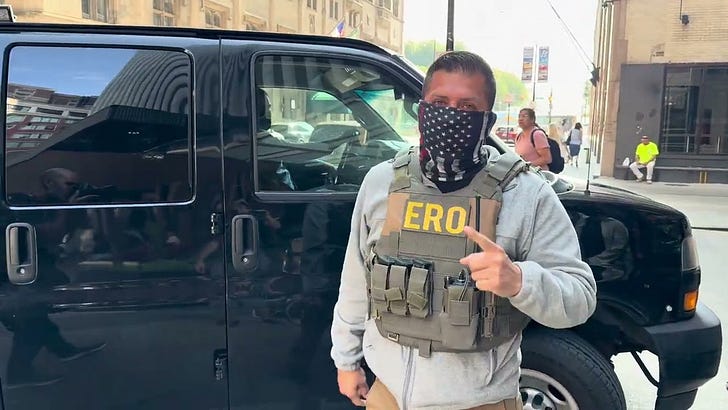
WASHINGTON — It was a day for counting heads and checking spines, and when the roll call was finally finished on the floor of the House of Representatives this afternoon, the Democratic Party found it had exactly 207 backbones and seven rubber stamps.
The business at hand was the funding of the Department of Homeland Security, a sprawling apparatus that has grown from a bureaucratic panic attack into a domestic police force that currently specializes in kicking in doors and checking the papers of grandmothers. The bill on the table was a check for another $64.4 billion—enough money to keep the lights on at the detention centers and the gas tanks full in the deportation buses.
For the first time in a long time, the Democrats, 207 of them, stood up and said “No.” They looked at the polling numbers, which show the American public is finally getting sick of seeing families torn apart on the nightly news, and they voted against the money. It was a historic wall of opposition, a sign that perhaps the fever of mass deportation is finally breaking.
But then there were the Seven.
They are the “Frontliners,” the moderates, the ones who wake up in the morning terrified of their own shadows and go to sleep terrified of a thirty-second attack ad. They walked onto the floor and voted “Aye.” They voted to give the machine more gas.
Here is the roll call of the Seven who broke ranks to fund Trump’s secret police:
Laura Gillen (NY)
Jared Golden (ME)
Henry Cuellar (TX)
Tom Suozzi (NY)
Don Davis (NC)
Marie Gluesenkamp Perez (WA)
Vicente Gonzalez (TX)
To understand why they did it, you have to look at what they’ve been voting for all year. These are the same people who looked at the Kayla Hamilton Act and nodded their heads. That piece of work, passed in the dead of December, gave federal agents the power to strip-search unaccompanied migrant children, ostensibly and ridiculously to check them for “gang tattoos.” It turned the Department of Health and Human Services into a branch of the vice squad, all because these members are afraid of looking soft.
They are the same ones who lined up for the Laken Riley Act, a law that took the concept of “innocent until proven guilty” and threw it in the Potomac. That act mandated federal custody for migrants accused of minor crimes like shoplifting. Not convicted. Accused. It’s a law that says if you steal a candy bar and you weren’t born here, you don’t get a court date, you get a cage.
Take Henry Cuellar and Vicente Gonzalez. They represent the border districts in Texas, places where the local economy is practically built on the backs of the people they just voted to hunt down. They vote for this money because they think it buys them safety from the angry rhetoric of the right. It never does.
Take Tom Suozzi and Laura Gillen from New York. They watched the public mood shift in their own state, where the people are recoiling from the sight of ICE agents in the subways. Yet they voted to fund the very agents causing the panic.
And Jared Golden up in Maine, and Marie Gluesenkamp Perez in Washington, and Don Davis in North Carolina. They all made the same calculation: that it is safer to side with the badge and the gun than with the 207 colleagues who decided enough was enough.
The tragedy of the Seven is that they are betting on yesterday’s news. The polls are collapsing for ICE and the Border Patrol. The American people, who are generally decent when you get them away from a television screen, are seeing the cost of a police state—the cruelty, the expense, the sheer un-American nastiness of it—and they are turning away.
Today, 207 Democrats saw that turn and voted accordingly. They voted to stop the funding of a machinery that has lost its moral compass.
The Seven voted to keep the gears grinding. They wanted to be on the side of “law and order,” but all they ended up doing was signing the check for more misery.