
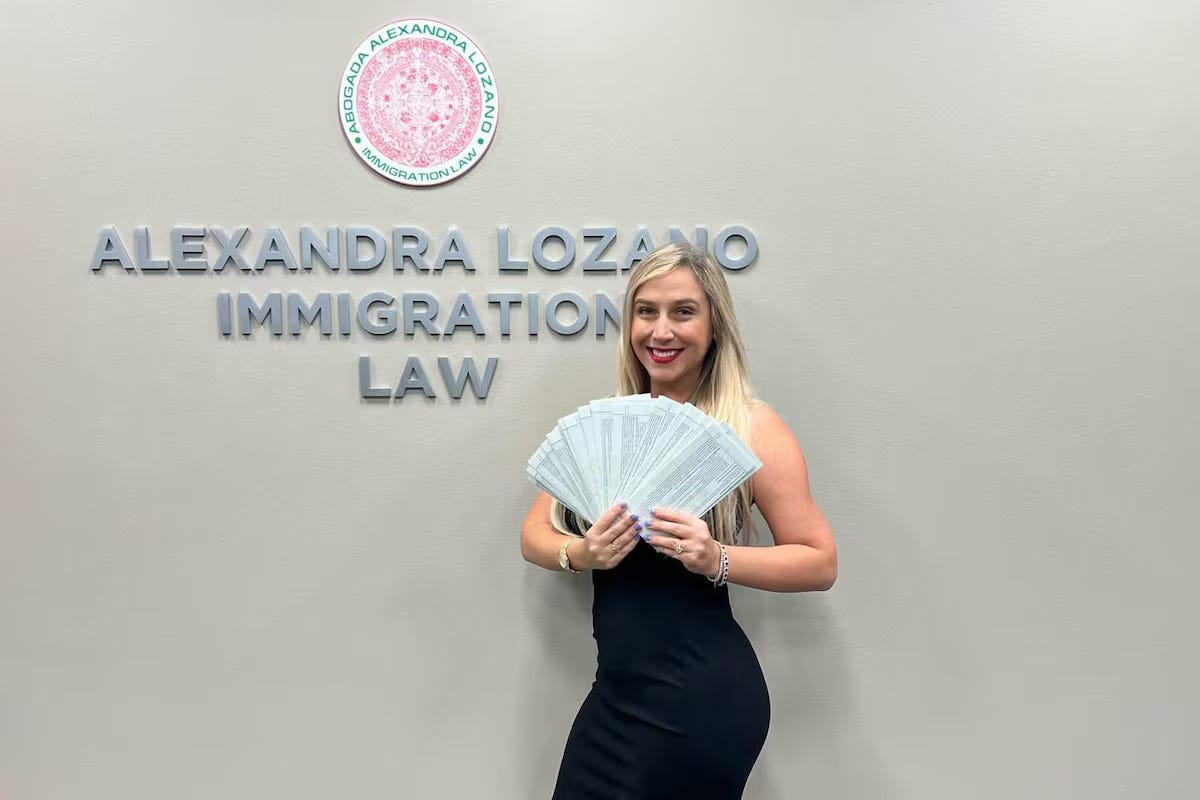
WASHINGTON — The last confirmed sighting of the woman who called herself the abogada de los milagros was on a screen.
It was June 10, the day Luz Legal shut down for good, and according to three former staffers who spoke to The Seattle Times, Alexandra Lozano — who had surrendered her Washington law license two weeks earlier and was therefore supposed to have nothing to do with the firm — was on the company chat, on the email chain, and helping lead a virtual meeting. Then the offices in Tukwila and Yakima and Fresno and Berwyn went dark, the signage came off the glass, and the woman went with them.
Eleven weeks later, nobody in the American legal system can say where Alexandra Lozano is.
Not her own attorney, Angelo Calfo, who according to the Latin Times did not respond to requests for comment on the newest allegations against his client. Not the plaintiffs’ lawyers, whose amended complaint states she has left the jurisdiction of the Western District of Washington. Vicente Omar Barraza, the Seattle attorney leading the first suit, put it to a Spokane reporter in seven words: “We are not sure where she is.”
What she left behind is not a mystery at all. It is nearly 54,000 pending immigration petitions bearing her signature, roughly 35,000 clients, and a federal fraud allegation that Barraza has called “the biggest immigration fraud case in American history.”
The people she took
Understand who these clients were, because the record is unambiguous on this point and it is the part most likely to get flattened in the retelling.
These were people trying to do it the legal way. That is the whole tragedy. A person who wanted to stay in the shadows didn’t need Alexandra Lozano. The people who walked into her offices — many of them monolingual Spanish speakers, long-term residents with U.S.-citizen kids, mixed-status families — walked in precisely because they wanted their names in a federal file, on a form, in the light. They paid $10,000 to $15,000 for the privilege. They financed it. They borrowed against it. Susan Pai, the Des Moines, Washington, attorney compiling client accounts, described one family that stopped buying meat for three years.
They were sold a woman who posed with the Virgen de Guadalupe, who ran “Milagrosa” tours through the Central Valley, whose shuttered Fresno office still has religious glass candles inside and the words protección, permiso, papeles on the wall behind the missing furniture.
What they got, according to the lawsuits and the bar’s own statement of misconduct, were fabricated abuse stories. Domestic violence they never suffered. Trafficking that never happened. Declarations they never read, filed under signatures some say they never gave. Plaintiffs’ lawyers call it “narrative engineering.” Barraza describes an assembly line — clients signed up, never refused, never actually evaluated.
Hundreds of the people writing those narratives were in Colombia, Mexico and Argentina — 400 in Colombia alone, according to a declaration Lozano’s own attorneys filed in unrelated litigation. Many clients never spoke to a licensed attorney at all.
Some learned what had been filed in their names only at a green card interview. One woman, previously reported to have lived in Seattle for 27 years, learned at the border — after traveling to Mexico to care for her sick father — that she could not come home.
The restitution that isn’t
Here is where the accountability story breaks down, and it should be said plainly rather than dressed up.
The Washington State Bar Association told The Seattle Times in July that it is formulating a restitution plan. The catch, which bar officials themselves acknowledge: the bar cannot enforce it. Each of the 35,000 former clients would have to sue Lozano individually. The bar’s Client Protection Fund — the resource of last resort — held just over $6 million as of March. Divided across the client base, that is roughly $170 a person.
On Aug. 3, the bar’s Disciplinary Board appointed two custodians, attorneys Adam Boyd and Russell Aoki, to take possession of client files and trust account funds. That came nearly two months after the firm closed. Files are still incomplete. Some clients received folders containing blank forms. Others are still watching automatic Luz Legal payments come out of their checking accounts.
The federal role has been narrower than the scale demands. USCIS issued a public notice on June 26 — a rare step — urging former clients to update their mailing addresses so notices go to them rather than to a shuttered law firm. The Board of Immigration Appeals suspended Lozano from practice before DHS, the immigration courts and the Board on June 18. USCIS’s fraud unit is examining humanitarian filings. That is the extent of what has been announced.
Pai says it goes further. “I can confirm that the feds are investigating Ms. Lozano for crimes,” she told KING 5 in June; four other attorneys confirmed federal involvement. No charges have been filed. No arrest has been announced. Through his client’s denial, Calfo has said Lozano “will address those allegations fully in court,” and that thousands of her clients did obtain legal status.
What the government has not built is a mechanism to distinguish a victim from a fraudster. Right now, a woman who never knew a fabricated abuse claim was filed under her name carries that claim as her own. Fresno attorney Olga Grosh told Fresnoland that a presumption of fraud now shadows VAWA applicants generally — including people who never heard of Alexandra Lozano.
What is actually being chased
The civil case has grown from nine plaintiffs to 34, with roughly 5,000 more people contacting the legal team. A second proposed class action landed June 15. Together they allege Lozano generated more than $400 million in revenue or committed fees, calculated from her average fee against her client count.
The plaintiffs want a judge to put her assets in trust for her former clients. Among them: a pink-and-white Bombardier jet valued at about $25 million, first purchased by a Washington company where Lozano was the sole listed governor, later moved into an aviation trust. Multimillion-dollar homes, including property in Mexico.
The jet has flight records. The homes have deeds. The 54,000 people do not have their files.
Fresno immigration attorney Lazaro Salazar, who has consulted with some 25 to 30 former Lozano clients and estimates fewer than half have cases that can still move forward, offered the only counsel available to anyone still waiting: “be honest with ourselves and not hope for the miracle.”
Migrant Insider is still reporting this story. If you were a Lozano client, worked at Luz Legal, or wrote declarations for the firm from Colombia, Mexico or Argentina, we want to hear from you. We can speak in Spanish, and we can talk off the record. tips@migrantinsider.com or Signal pab.202


Everyday, it keeps getting worse. Thanks for your reporting, Pablo.
I am always skeptical of people who say things like the biggest in history. So often they seem to have a limited grasp on history. Lozano has been a known entity for a good decade. At least some lawyers will get to jump up and down on camera now. Our systems are broken because our populace is poorly educated [even those with lots of paper] and has a general refusal stance when it comes to learning about the country in which we live. We have to fix the education system. Everything starts there.