
Three Judges, Three Presidents, One Answer: Feds Can't Shoot Journalists Covering ICE Raids
9th Circuit affirms preliminary injunction but orders district court to narrow its scope.
WASHINGTON — A federal appeals court panel that crossed every line of presidential appointment upheld a preliminary injunction Wednesday shielding journalists, protesters, and legal observers from the indiscriminate use of crowd-control weapons by federal immigration agents — a ruling that carries extra weight precisely because of who signed it.
Judge Mark J. Bennett, a Donald Trump appointee, joined Clinton-era Judge Ronald M. Gould and Obama pick Jacqueline H. Nguyen in affirming that the Department of Homeland Security and Secretary Kristi Noem likely violated the First Amendment when federal agents — drawn from ICE, Customs and Border Protection, and the Federal Protective Service — opened fire on members of the press and peaceful demonstrators during anti-ICE protests across Southern California in the summer of 2025.
The ruling was unanimous. That matters, especially for outlets like Migrant Insider where this is our 165 story about ICE during Trump’s second term. We couldn’t do it without the support of our paid subscribers and and founding members here on Substack. Consider upgrading your subscription if you can.
WHAT THE RECORD SHOWED
Writing for the panel, Judge Gould did not mince words about what the record showed: federal agents shot a protester in the head, legs, and feet with pepper balls at close range while the person was complying with orders. A member of the press was struck in the head with a rubber bullet and sustained a concussion. Another reporter was hit in the arm by a tear gas canister while retreating — diagnosed with a hematoma and treated for a burn. A fourth person was hit in the hand by a canister fired from 50 to 75 feet away, requiring stitches.
“In some instances,” the court found, “officers issued no warnings and shot individuals who posed no threat to the officers or to any other person.”
DHS DEFENSE FALLS FLAT
The government’s defense — that the injuries were incidental to controlling violent protests — landed with a thud. The district court had “carefully reviewed each incident,” the 9th Circuit noted, and rejected DHS’s alternative explanations. Having policies on paper prohibiting the targeting of sensitive body areas meant nothing when agents were aiming at heads anyway.
“A plaintiff can show a custom or practice of violating a written policy,” the panel wrote; “otherwise an entity always could avoid liability by pointing to a pristine set of policies.”
The court found what it called an “avalanche” of circumstantial evidence that federal officers were specifically targeting journalists and legal observers standing far from any protest activity — a finding that satisfied the First Amendment retaliation standard even without a federal agent confessing intent on the record.
WHO SUED — AND WHO HAS STANDING
The Los Angeles Press Club and NewsGuild-Communications Workers of America joined individual journalists, legal observers, and protesters as plaintiffs. The 9th Circuit found all of them had standing — including the organizations, whose institutional interests were deemed sufficiently tied to the lawsuit’s core claims.
WHERE THE INJUCTION WENT TO FAR
The panel did not, however, give the district court’s injunction a clean pass.
Gould and his colleagues found several provisions overreached — protecting “any person” from tear gas canisters and flash-bang grenades, shielding all journalists and legal observers from dispersal regardless of individual standing, and imposing a dual audible warning requirement the court said invited “strategic or near-frivolous contempt proceedings.” Those sections, the court ruled, went further than the law allows after the Supreme Court’s 2025 decision in Trump v. CASA tightened standards on broad injunctive relief.
WHAT SURVIVED
What made it through scrutiny: the prohibition on firing kinetic impact projectiles at the head, neck, groin, back, or other sensitive areas. That provision, the court held, was directly tethered to the documented harm.
WHAT COMES NEXT
The case — Los Angeles Press Club v. Noem, No. 25-5975 — now returns to District Judge Hernan Diego Vera in the Central District of California to craft a narrower injunction consistent with the appeals court’s guidance.
For reporters covering the immigration beat, the message from all three judges — regardless of who put them on the bench — was consistent: the press does not forfeit its constitutional protections when it shows up to cover the government doing its work.
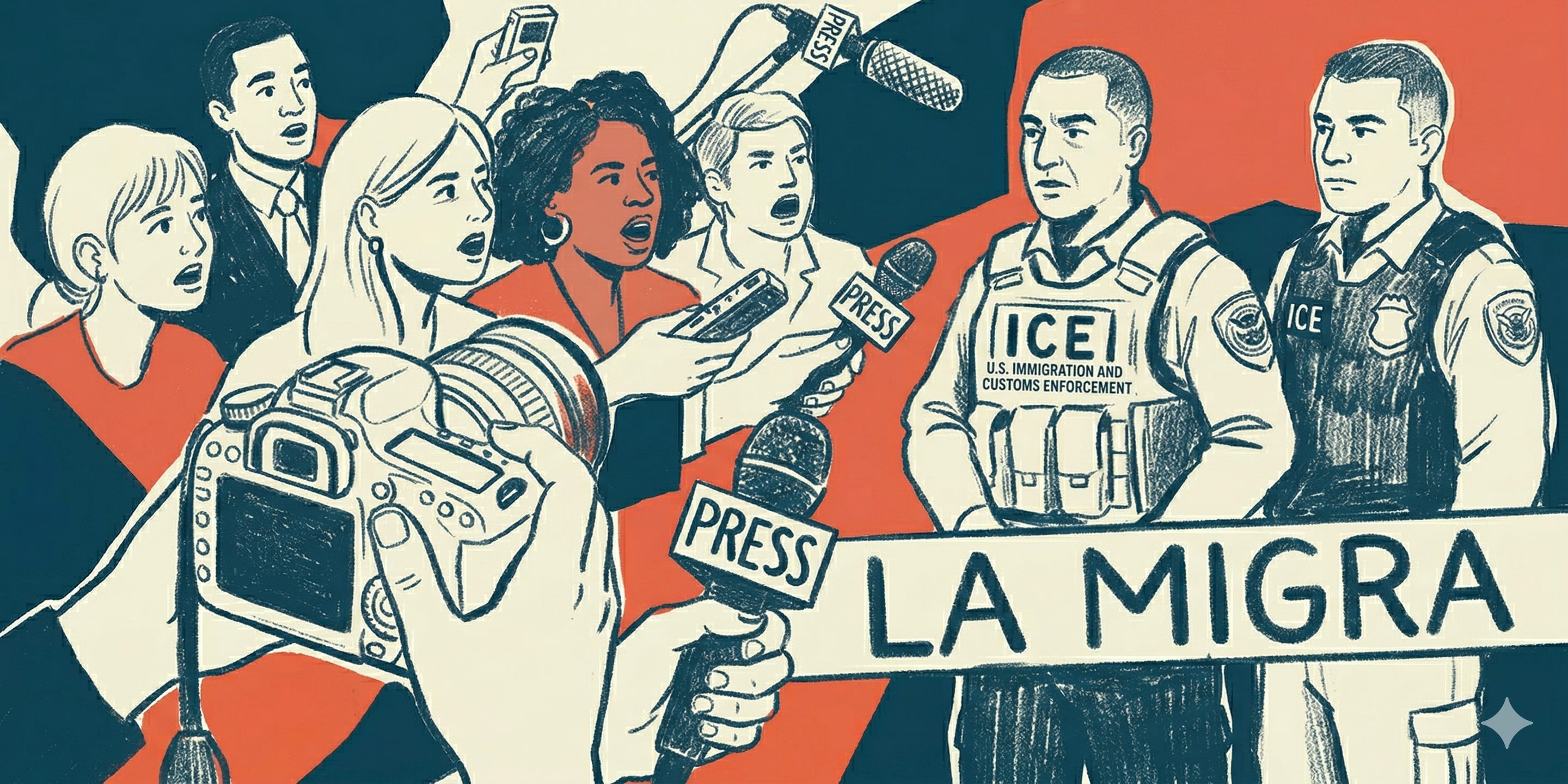
EDITOR’S NOTE: If you’ve made it all the way to the bottom, I’m curious: What do you think of the banner graphic at the top of this post? Most of my posts include no images. Do visuals like this improve your reading experience of Migrant Insider?


How do you attach PDFs like that?! So cool!
The graphic shows up when I share to my social media and should grab more attention.