
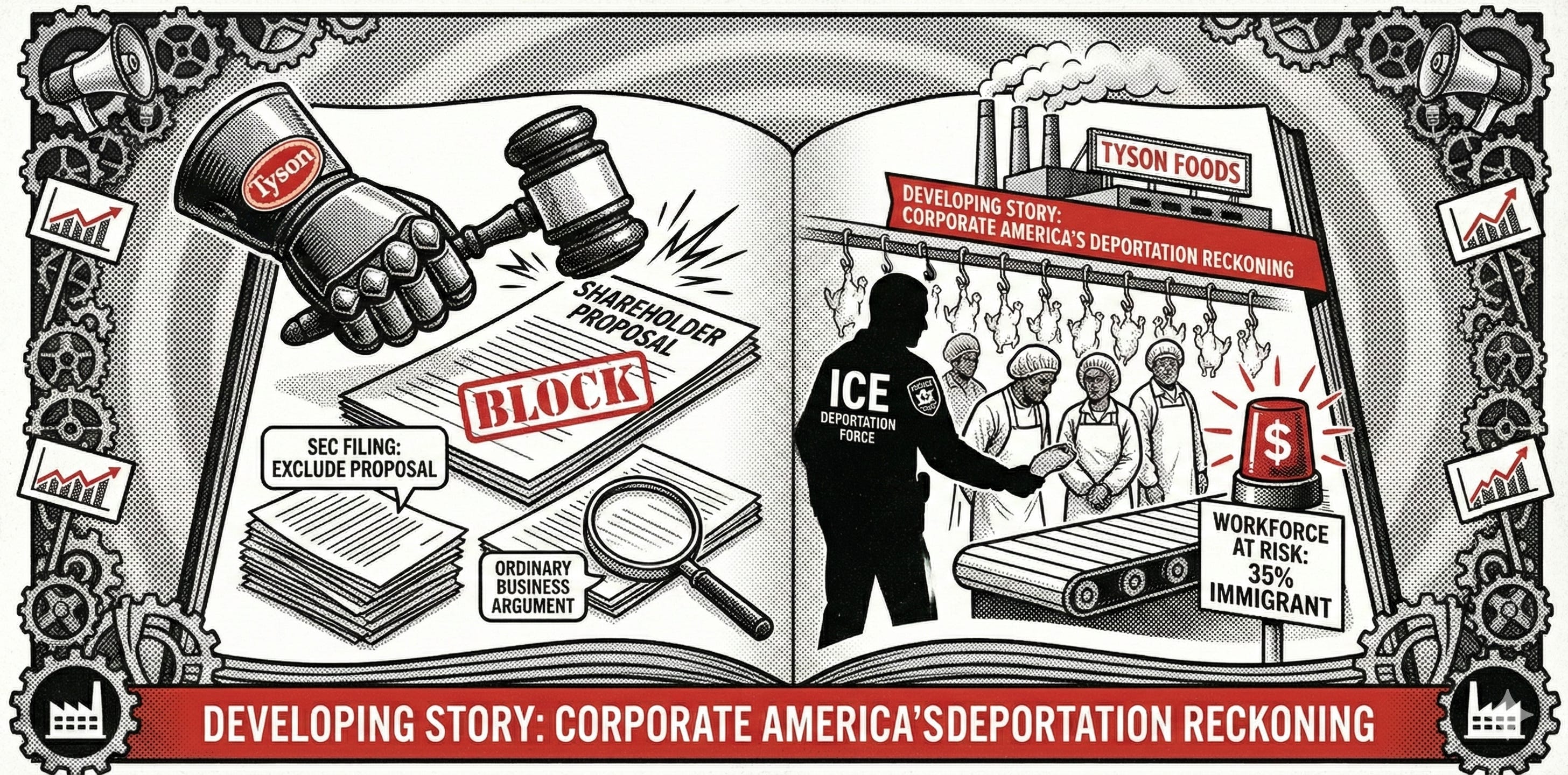
SCOOP: Tyson Foods Moves to Block Shareholder Vote on Deportation Risks
The meat giant is fighting to keep investors from demanding a report on how mass deportations could devastate its workforce — 35% of which is immigrants.
WASHINGTON — Tyson Foods is quietly fighting a shareholder attempt to force the meat processing giant to disclose the financial risks posed by the Trump administration’s mass deportation agenda, Migrant Insider has learned.
According to a legal filing obtained by Migrant Insider, the company is seeking permission from the Securities and Exchange Commission (SEC) to exclude a shareholder proposal from its upcoming 2026 proxy ballot. The proposal, submitted by the Sisters of St. Francis Charitable Trust, demands a report on how “recent changes in United States (US) immigration law, policies, and enforcement priorities” will impact the company’s finances and operations.
While the legal filing uses the sterile language of corporate governance, the stakes are existential. The proposal explicitly cites the “unpredictable elimination of work authorizations” and notes that 35% of Tyson’s workforce is comprised of immigrants.
The Inside View
Tyson’s resistance to the vote highlights a growing fissure in corporate America, where shareholders are beginning to demand that companies account for the operational realities of the administration’s hardline immigration enforcement.
A source working closely with Tyson’s board on the matter, but who declined to be named in order to discuss internal company deliberations, confirmed to Migrant Insider that this proposal is part of a coordinated, behind-the-scenes effort by investors to push for incremental corporate actions in response to the threat of mass deportations.
“We would like to urge shareholders to support our resolutions at shareholder meetings,” said the source who is part of a conscientious group of corporate investors and advisors who plan to engage with “a number of portfolio companies in 2026” — not just Tyson.
“Ordinary Business”
In its letter to the SEC, attorneys for Tyson argue that the proposal should be blocked because it interferes with “ordinary business operations” and seeks to “micromanage” the company.
“The Proposal addresses the Company’s workforce management and legal compliance functions, which are fundamental aspects of the Company’s ordinary business operations,” Tyson’s legal counsel wrote. They argue that shareholders do not have the expertise to judge complex immigration compliance issues.
The filing reveals the company’s defensive posture. Tyson argues that because it already participates in E-Verify and the IMAGE program (a partnership with ICE), it is “well-equipped” to handle labor disruptions. However, the shareholders argue that mere compliance doesn’t account for the “risk of violating the law” or the “production by 70%” reduction seen at peer companies following enforcement actions.
The Wider Trend
While Tyson is one of the first major U.S. corporations to face a formal shareholder reckoning regarding the new administration’s deportation campaigns, a source close to the board confirmed Thursday that similar resolutions are being drafted for other major employers in the agriculture, hospitality, and construction sectors.
Investors are no longer satisfied with vague assurances about diversity; they want hard data on what happens to the stock price if ICE raids clear out the factory floor.
Tyson expects to file its definitive Proxy Statement by December 17. Whether the SEC allows them to silence this vote will be a bellwether for how much transparency corporate America owes its investors regarding the human cost of the current immigration crackdown.
This is a developing story. If you have tips on internal corporate memos regarding immigration enforcement, reply to this email.
Follow us on YouTube.


Please keep us posted. This could have far-reaching consequences and concerns and also, appears to be a microcosm of what’s going on with other corporations that we don’t yet know about. Excellent reporting.
Why beef 🥩 cost 💲 exploded