
Inside the Rising Grassroots Resistance to Trump's Anti-Migrant Regime
Across red states and blue cities, extraordinary people are throwing themselves before the gears of Trump's deportation agenda.

JACKSONVILLE, FLA. — Not unlike his first presidency, the second Trump administration has ignited local communities into widespread, grassroots political organizing. Some have founded entirely new community advocacy organizations, while others have created vetted, neighborhood-wide signal chats. No matter the state, city or county, countless ordinary folks have wasted little time putting themselves before the gears of Trump’s anti-immigrant machine.
In direct response to Trump’s reelection and inauguration, local organizers in northeast Florida founded the Jacksonville Immigrant Rights Alliance (JIRA) in January of 2025. Being a political advocacy organization primarily focused on aiding directly affected community members, i.e. immigrants, JIRA makes sure to spend good time disseminating important legal information across Jacksonville, Florida.
One way JIRA does this is through Barrio Walks – where organizers canvass door to door spreading know your rights information.
“These are people who otherwise wouldn’t have access to know your rights material in Spanish because they don’t even know what to look for or they think maybe they need access to a lawyer,” said Vanessa Alvarez, a community organizer with JIRA.
Barrio walks, Alvarez told Migrant Insider, have been an excellent way to connect with the community. In addition to informing the most vulnerable of their rights, JIRA has also met with less-affected people who stand sympathetic to their cause, expanding the immigrant rights movement further.
Importantly, JIRA’s Barrio walks have connected immigrants with activists who can help assess and meet their needs in times of crisis, something Alvarez described as “unprecedented.”
“The reception we get from those in the affected communities is just pretty magical,” shared Alvarez.
Nationwide Grassroots Resistance
Like most things, resistance doesn’t operate in a vacuum. Activists across the country keep in contact with each other – they talk – and they share strategies, ideas, and tactics of dissent.
JIRA itself is affiliated with the Legalization 4 All Network – a nationwide grassroots advocacy organization demanding legalization of all 11 million and counting undocumented immigrants residing in the United States. It’s through this national affiliation that JIRA has learned from other activists around the country – implementing lessons into their local work – including the Barrio walks.
“It’s really neat to have people from all different backgrounds and perspectives come together and do something that is helping others,” said Alvarez.
Cooperation between activists and communities doesn’t just stop at the sharing of ideas. On Feb. 6, the Legalization 4 All Network, in conjunction with JIRA and other affiliated immigrant rights groups in Tallahassee and Tampa Bay, Florida called for a state-wide weekend of action to support the VISIBLE act in the Florida legislature – a bill that would unmask immigration enforcement officers.

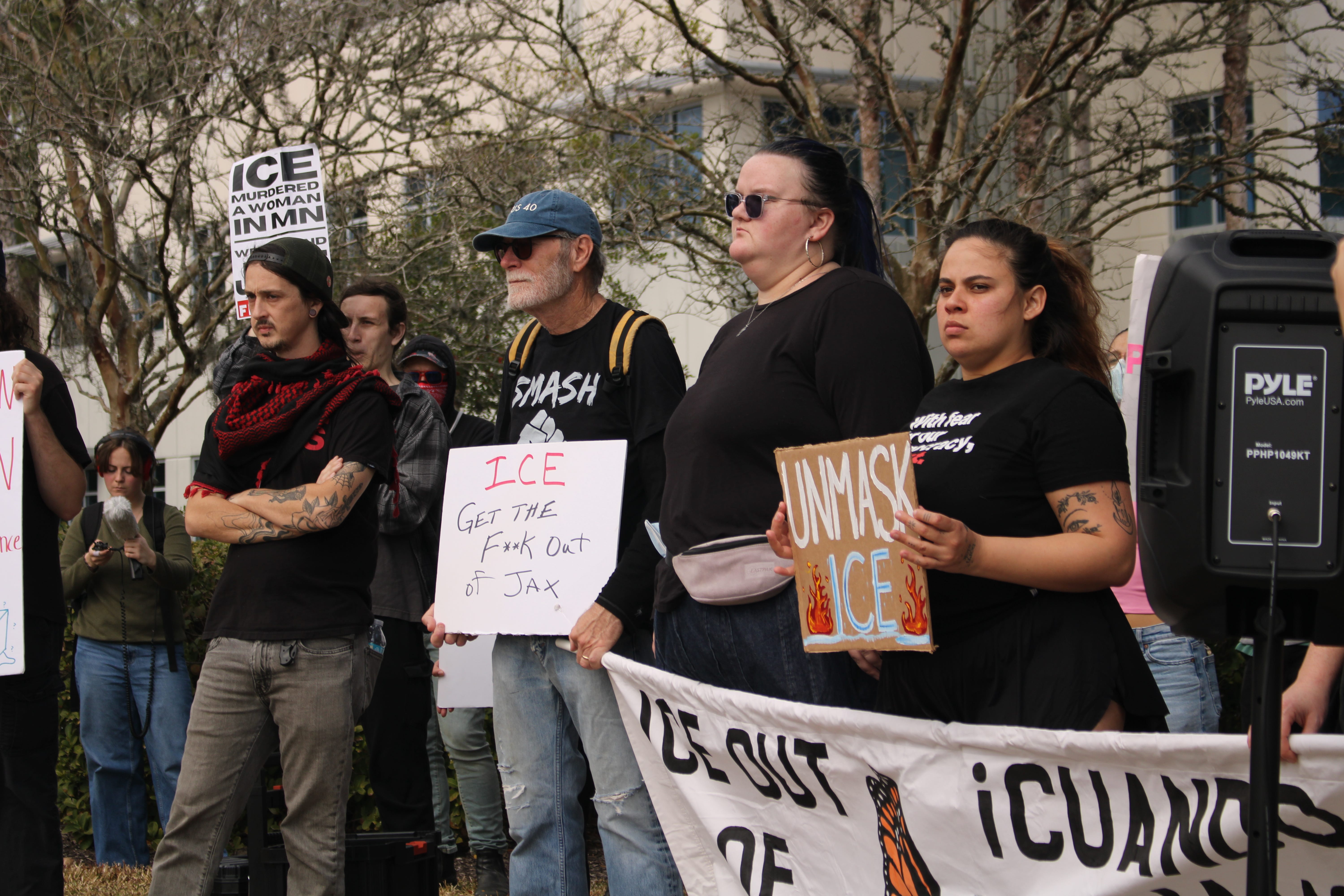
“The broader ask now is to unmask ICE because they’re using masks to conceal their identities and then commit crimes such as illegally detaining people and murdering people,” said Alvarez, protesting with JIRA outside a Jacksonville ICE field office on Feb. 15.
No matter where you look, whether it be the bluest, most liberal cities in New England or the reddest, most rural towns along the bible belt – communities across the states are responding to Trump’s increasingly brutal immigration agenda with initiative.
As reported on Feb. 14 by the Marshall Project, community members in Phoenix, Arizona packed a city council meeting to oppose the sale of a local warehouse to the Department of Homeland Security (DHS). The department’s acquisition of warehouses around the country is part of a broader effort to rapidly expand detention capacities. Like other detention center construction projects such as the so-called Alligator Alcatraz in the Florida Everglades, local community members sprung at the opportunity to oppose further expansion of Trump’s immigration regime.
MY TAKE: The principal example of Minneapolis showed us what can happen when the mass citizenry comes together to document, confront, and defend their communities from ICE agents. But Minnesota also showed us what the federal government is willing to do in response to an engaged citizenry. Federal agents were willing to kill Renee Good and Alex Pretti in broad daylight. While the death of these two Minnesotans certainly energized activists from around the union, all Congress has done in response is draw out funding negotiations for DHS in hopes to extract moderate reforms.
Despite the continual assault on immigrant communities by federal officers – and the government’s rubber stamping of it all – grassroots resistance continues to spring up, and community members continue to do what they can.


💙💙💙
We need to get rid of AIPAC, have healthy elections without interference: United Democracy Project, the super PAC officially aligned with AIPAC, has spent more than $3.1 million in the Seventh Congressional District to support Melissa Conyears-Ervin, the Chicago city treasurer.