

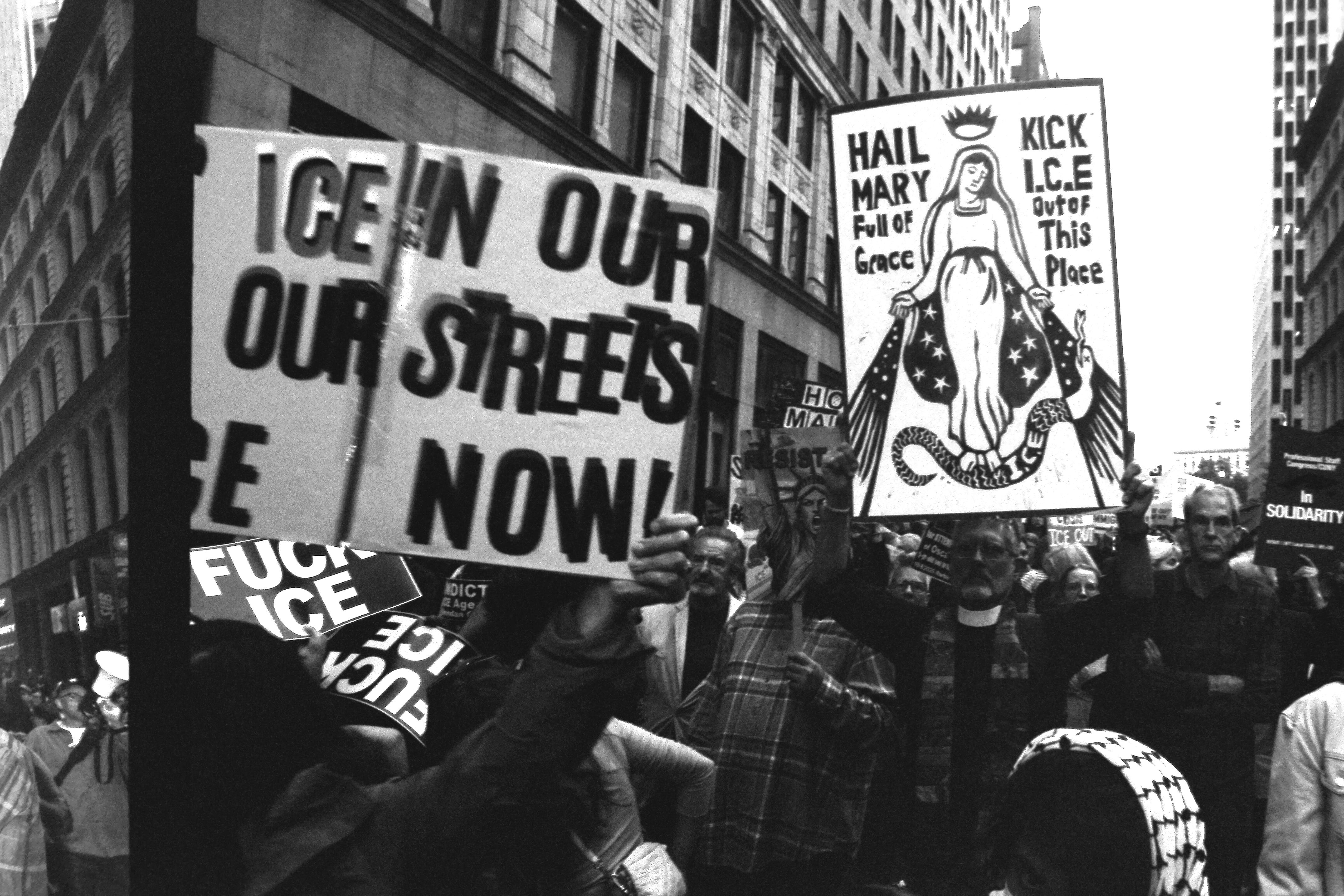
WASHINGTON — On June 23, two Homeland Security personnel walked into the Central Library in Syracuse, N.Y. It was primary day, and the library was a polling place. They were there for an election inspector named Paigelynne Gonyea — to deliver a warning about an Instagram post she had written criticizing an ICE officer.
No voters were inside at that moment. No ballot went uncast. Gonyea invited the agents in because she did not want to meet them alone outside.
That scene is 2026 in miniature. Not a stormtrooper at every precinct — the evidence doesn’t show that — but an immigration agency that now knows where the poll workers are, what the voter rolls say, and how to make a visit felt.
With ten days to go, here is the paper trail.
The paper trail
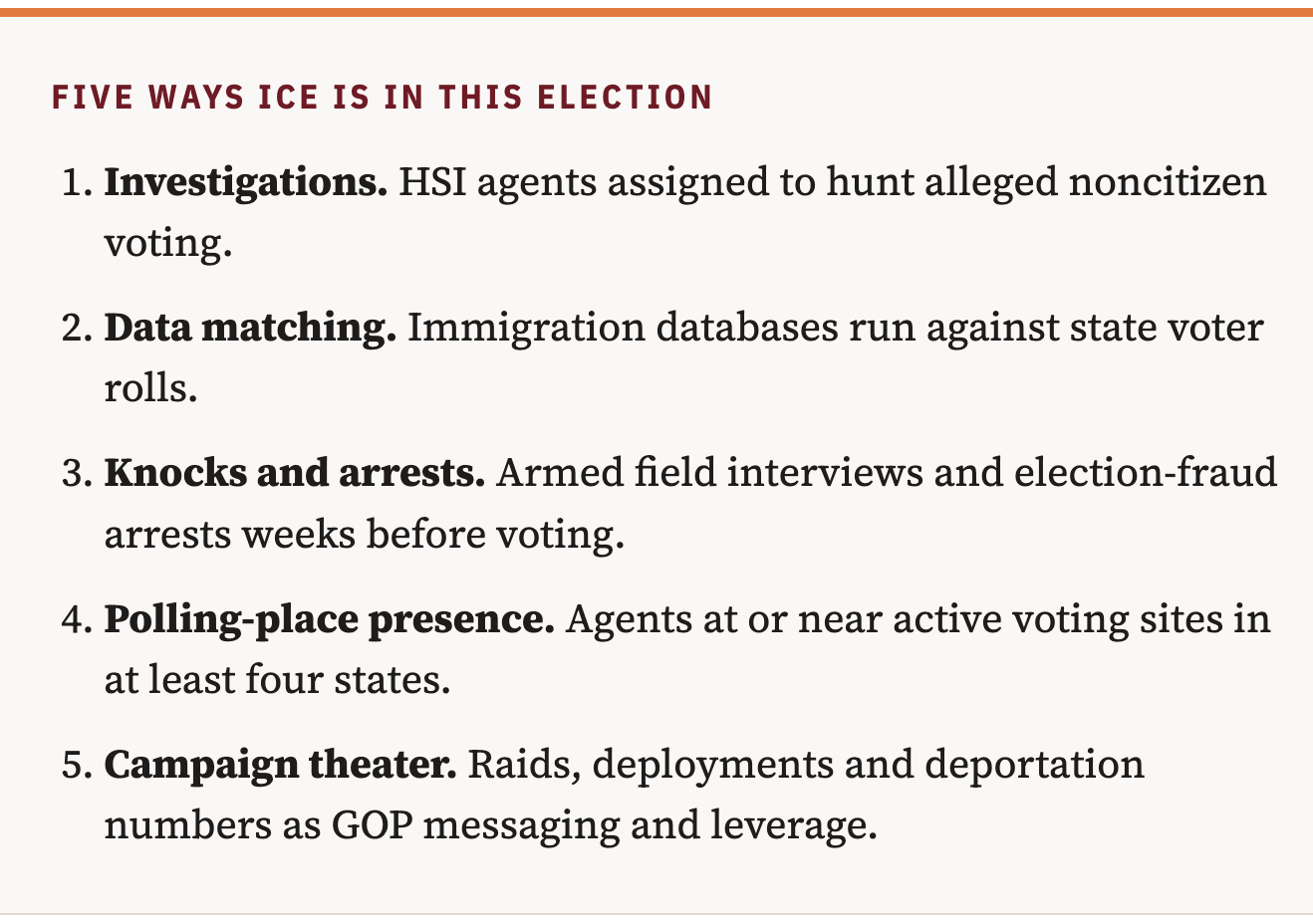
It starts with Executive Order 14248, signed March 25, 2025. It told DHS to compare state voter-registration lists against federal immigration databases and to feed the Justice Department information on foreign nationals who said on immigration forms that they had registered or voted.
In May, a Justice Department Office of Legal Counsel opinion supplied the next piece: DOJ could demand statewide voter files and hand them to Homeland Security Investigations. The opinion doesn’t bind states, and several courts had already said states weren’t obligated to turn the data over.
Then came the people. According to The Washington Post, hundreds of immigration employees who normally process applications for legal status were reassigned to comb voter data for noncitizens. Internal records show investigators had access to roughly 99 million records.
The knock at the door
Internal guidance describes an HSI “criminal voter fraud” surge in nine states: California, Connecticut, Georgia, Missouri, Nevada, New York, Pennsylvania, Washington and Wisconsin. Armed agents visited homes and asked residents about citizenship, registration and past voting. HSI’s Kansas City account posted a photo captioned “AMERICAN ELECTIONS ARE FOR AMERICANS.”
Since late August, ICE has also asked people it arrests whether they have ever voted illegally. Since Oct. 1, those who say yes are asked whether they voted in person or by mail. A civil immigration arrest is now an election-investigation intake desk.
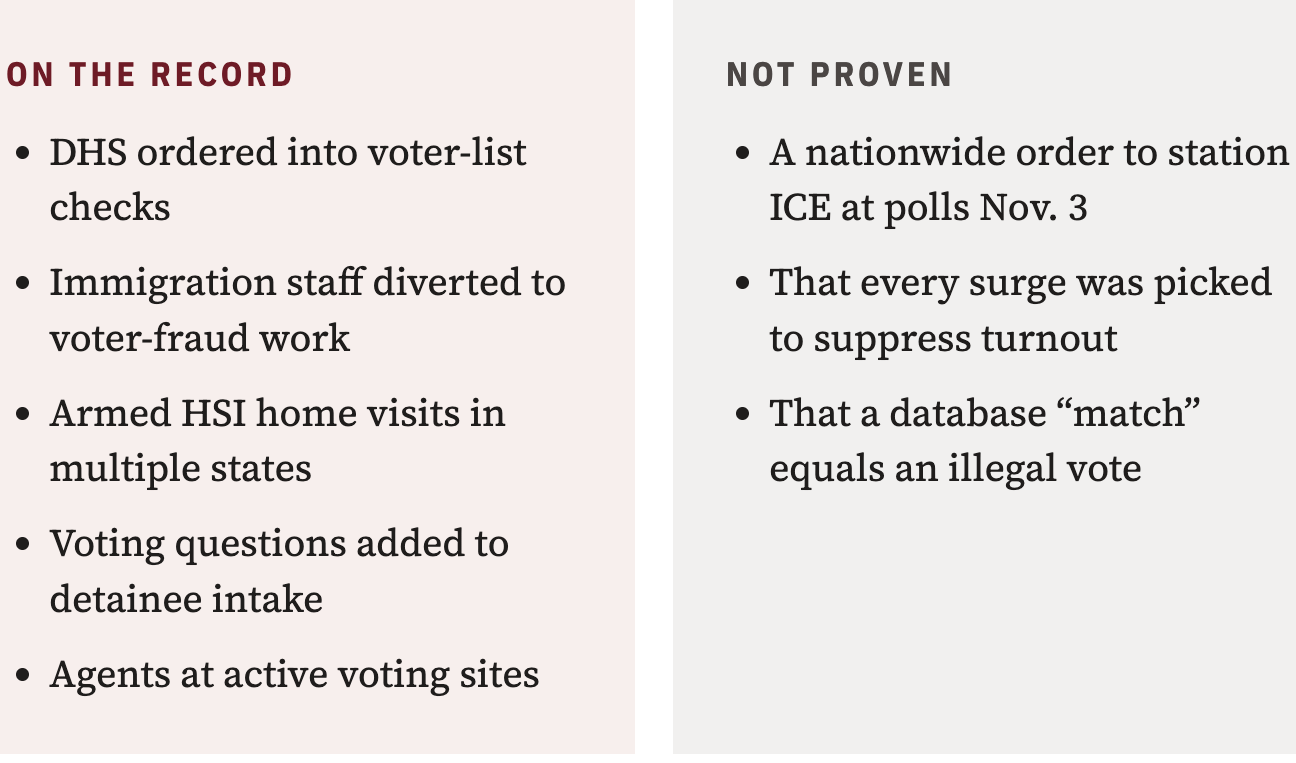
The machine’s weak joint is the data. In Nevada, DHS first flagged thousands of possible noncitizens, then told state officials that 185 had been manually verified as highly likely noncitizens — with thousands more never vetted.
On Oct. 21, a federal judge restricted DHS field operations in all nine states, finding the work likely violates the Voting Rights Act’s ban on intimidation. Agents may not target known or reasonably suspectedU.S. citizens, or act on USCIS matching data alone. The order runs through election night, subject to appeal.
California, ground zero
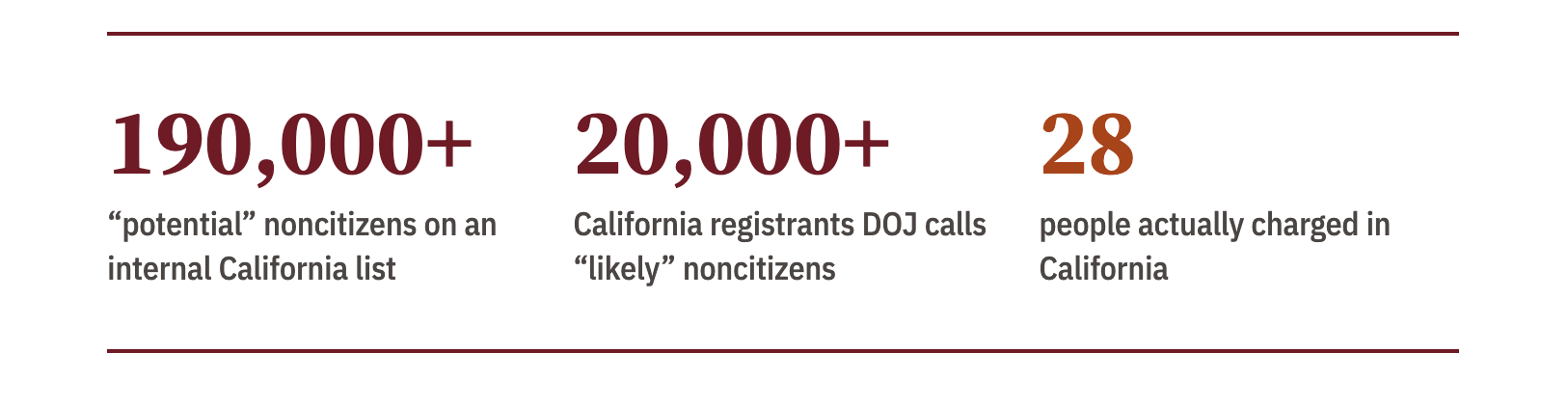
On Oct. 19, federal authorities arrested 11 lawful permanent residents and announced charges against 28 people under “Operation Protect the Vote,” a joint push by all four California U.S. attorney offices. Charges include fraudulent registration, illegal voting and false statements in naturalization cases. ICE personnel joined at least one attempted arrest, in Petaluma, with a local TV crew along.
Mail ballots were already out. DOJ and DHS have also sued California to stop it from counting ballots from the 20,000-plus listed registrants unless their citizenship can be verified. Los Angeles County’s first sample found canceled registrations, people with no voting history — and some records showing a U.S. birthplace.
Charges are allegations. And a list is not proof.
The polling-place fog
Asked in May whether he would send the National Guard or ICE to polling places, Trump said he would do “anything necessary” to ensure honest elections. He did not rule it out. DHS’s formal line: “ICE is not planning operations targeting polling locations” — while leaving room for a warrant or a public-safety threat. Border czar Tom Homan says there is no plan to sweep polling places.
The record so far: nine agents in an early-voting parking lot in Bexar County, Texas, in May, until the sheriff told them to leave. ICE vehicles at a Simi Valley, Calif., vote center for about 30 minutes on June 2. Syracuse on June 23. This month, Border Patrol vehicles at a Leon County, Fla., library poll and masked federal agents conducting a stop at a Key Largo polling place.
None of those, on the public record, disrupted a single ballot. None proves a central order. All of them are why seven states have now written limits on armed agents near the polls into law.
The campaign prop
The political use is the easiest part to document. NPR counted nearly 300 Republican immigration ads from January through June, against 62 from Democrats — about $53 million in GOP spending across 88 races. Outside a Trump rally in Ohio, vendors sold ICE caps.
ICE has also been a threat aimed at specific opponents. After Zohran Mamdani won New York’s Democratic mayoral primary on a promise to resist ICE, Homan said “game on” and vowed to send more agents. In Minnesota and Maine, surges and fatal encounters landed in the middle of open Senate fights.
What we’re watching on Nov. 3
Any warrant service, stop, staging area or publicized arrest near a polling place, drop box or election office — measured against DHS’s own promise and the Oct. 21 court order.
See agents near a voting site? Signal me at pab.202, or by email at editor@migrantinsider.com. Send the time, the place, the vehicles and any agency markings. Photos help. We verify before we publish.
The frame isn’t “ICE at every poll.” It’s this: the government that runs deportations now also runs a voter-fraud dragnet — and wants you unsure which one is coming to your community.
Apologies for being radio silent for a few days. I was feeling under the weather. Stay safe out there and be sure to join my chat if you haven’t already:
